Man vs Machine

So, Big Data. The market research industry continues to struggle with the concept. It was one of the buzzwords of 2013. Some have come up with a big data offering. Some are searching for a point of view on it. Some counter with small data. Many still have only a vague sense of what we are talking about.

I have asked many colleagues and clients what this concept means to them, in the hopes of developing a brilliant solution that would make me wildly successful. Well, this seems to be taking some time, but anyway, I’d like to share with you what I have learned so far. As I am working in the healthcare sector, this is my focus below.

1. Big Data (in Pharma) is IMS data

For some of my pharmaceutical clients, all they can think of when asked about large data sets is IMS data. IMS captures and sells information about the prescribing behaviour of physicians at the pharmacy level. Through this data, pharmaceutical companies track the sales of their products.

2. Big Data (in Hospitals) is Patient Records and Interaction Statistics

Healthcare providers, particularly hospitals and other large organizations, capture myriads of data on patients flowing through the system. The analysis of this data is largely off the radar screen of traditional market research, and falls under the discipline of health informatics.

3. Big Data is Social Media data

This is a view that many market researchers adopted when social media first appeared on our professional horizon as another form of human expression. Last year’s MRIA NET Gain conference, dedicated to big data, featured a number of presentations in this area.

For those who do not want to develop their own proprietary solutions, subscription-based social media analysis tools are available and used by both end clients and market research vendors.

4. Big Data analysis is a different way of saying Data Mining

Some sectors have worked with large data sets for some time. I am thinking of scanner data in retail, and loyalty programs (Air Miles, Petro Points etc.). Fifteen or so years ago, the statistical techniques used to sift through such data sets were called ‘data mining’.

This practice is still ongoing, and the size of data sets ever increasing with more and more customer touch points being added. Some think of this type of analysis, when hearing the words big data.

5. Big Data is Data that is created by Machines

This type of big data is rarely mentioned and obviously not in the forefront of a market researcher’s mind. However, it has grown exponentially and is increasingly viewed and used as a source of customer information.

For market researchers, the question (and the fear) is to what extent human analysts are still needed, and to what extent ‘the machine’ can do it on its own. And how we can make sure we are still needed.

We say: “You need an expert to interpret what your data means.” We say: “A consultant is needed to guide the analysis process.” We say: “Meaningful data analysis is the development and testing of hypotheses, and only people can come up with those.”

And we are right.

How many times have I looked at the results of a statistical analysis and said, “This does not make any sense.” And then we discarded the analysis and started fresh, because results need to make sense. To another human. To your client. They need to lead to actionable insights and recommendations.

So we are still needed. But…

But many, many processes are now automated, from data analysis over producing charts even to highlighting key insights in charts. Far fewer people are needed to work with the data then before. Take a look at www.beyondcore.com – will get you thinking.

Some companies function with very little market research, in the sense of interactions between real live researchers with real live respondents. Machine-generated user data that streams back from devices guides the refinement of these products. New Apps are developed by split testing and seeing how early users interact with certain features, following the logic of clicks. Service companies integrate their customer interface and CRM software with their enterprise management system. Automated cues let managers at different levels know how they are performing, and notify them if there is a problem.

Technical skills are essential for survival. How can you tell a successful agency these days? If you look at their ‘careers’ page, most of the open positions are for developers (i.e. IT people). Those who win in providing business intelligence are either companies who are focused on the digitalization and automation of data collection and analysis, or companies who make intelligent use of available software products and platforms within the research process.

Do you know what Hadoop is? A wireframe? CSS? If not, perhaps it is time to google it right now…

Man vs Machine


The Right to Choose

Recently, the CBC reported on a ten-year old girl, Makayla Sault, who was diagnosed with acute lymphoblastic leukemia, a cancer of the blood. The girl experienced severe side effects from the chemotherapy she was receiving and decided, together with her parents, to discontinue therapy.

Now, the Children’s Aid Society is getting involved with the intent of convincing the family to complete the course of therapy. The parents and the community they live in also fear that Makayla may be forcibly removed from home and given therapy against her will.

Do parents have the right to choose whether or not a potentially life-saving treatment is given to their child? Does the child have a say in this decision? Does the state have the responsibility to act in what is perceived as the best interest of the child, against the parents’ and the child’s wishes?

Let’s consider all the factors.

Deadliness of the disease. The form of leukemia that Makayla has can progress very rapidly and lead to death within a few months, if not treated. If it was a slower progressing disease, would it seem reasonable to let the parents decide on the course of treatment?

Chance of cure. If treated, there is a high chance of long-term remission or cure for a patient with acute lymphoblastic leukemia. Some quote the likelihood of treatment success as 75% or even higher. How does this information influence your view on the case? Does the parents’ decision seem responsible? Should the state step in?

What if treatment success was estimated at 50%? …at 30%? …at 10%? How would this influence your view on whose right it is to decide what to do? With a low chance of remission or cure, would it seem reasonable to allow parents to, basically, let their child die without having to go through the agony of chemotherapy?

Cultural context. The news coverage focused in on the point that Makayla and her parents belong to the New Credit First Nation, based in Ontario. Her family decided to try traditional remedies instead chemotherapy, and their local community has shown great support for their decision. The interference of the Children’s Aid Society is seen by some as another attempt of a government agency to take away native children, as had been done during the era of forced residential schooling.

How does the cultural factor influence your view on the case? Does being First Nation give Makayla’s parents more of a right to decide her destiny than being of Irish decent, being Jewish or being Iranian? What if the family belonged to a religious group that was viewed as being ‘extremist’? Would you feel the same about the case or different?

To what extent is the state responsible for the well-being of our children, and to ensure their well-being in the face of parental opposition? Laws and mechanisms to protect children against abusive parents certainly seem appropriate. How about protecting children against well-meaning but ill-informed parents? How about protecting children against well-meaning, well-informed parents who adhere to a different belief system? Difficult decisions.

Old World, New World

This is not about market research. When I woke up last night I had a vivid memory of standing outside a door in an apartment building in Germany. There was the door, thickly painted wood, and the doorbell that I was about to ring. The stone floor cold under my feet, grayish-white speckled, sort of like marble, but definitely much harder than marble. Quiet, cool air in the house, and faint noises from playing children in the courtyard. A few steps down, a landing with an old double window. The window sill about 50 centimetres wide, it had some potted plants of the durable, all-season nature.

So many times I have been to places like this, stood outside of apartment doors, slightly apprehensive. The setting evokes a range of associations. The building as a microcosm. People have lived together for many years. Someone lovingly waters those plants, and dusts them off every once in a while. The floor is kept spotless, and I am sure there is a schedule posted somewhere, that tells which party is responsible for cleaning which week.

Corridor German House

A place of comfort. A place of confinement. Long-standing relationships, set ways, ancient enemies. There probably is a lady on the third floor who bangs a broomstick against her ceiling every time the family above her is audible. The couple on the ground floor always gripes about people not cleaning off their shoes properly and trudging dirt through the house. When kids talk loudly on the steps, someone will stick their head out their door with a disapproving look.


Fast forward to Toronto, Canada. First of all, a lot of people here own their own home. And not just rich people. Many single-family dwellings are not more than ten, twenty years old. My house was built in the 1940ies and is considered ‘old’. Having your own house means a lot of things. It means making as much noise (inside) as you want. Children jumping down the stairs, jelling, turning your music up. There are no rules to follow (well, very few), no customs to adhere to. Wear what you want, talk however you want, cook whatever you want. You are free to strike new relationships, don’t have to follow ‘what is proper’. What is proper and acceptable is negotiated every single day as people of different cultural backgrounds mingle and co-exist. Make no assumptions about others – speak to them and see what they are all about.

Townhouse Canada

This place is new, feels new. The depth is lacking, the ties woven through centuries (unless you go into small towns and more traditional parts of the country). It is a country full of opportunities. You have a good idea, you can get things done, we can benefit from it, you’re in. Don’t worry if your email contains grammatical errors, if you speak with an accent. Here in Toronto, most people are from somewhere else.

Your house is a blank slate. Make of it what you want.

Disclaimer:

I realize that I am writing this from a particular vantage point (as one usually does!). In Canada, there are many people who do not have the same opportunities as they have been open to me. If you arrive without language skills (English / French), without family connections and without financial backing, getting a foothold and making use of opportunities can be tough. However, I argue that the opportunities here are still greater than if you were to arrive in Germany with the same skill set and resources.

Conclusion:

Germany and Canada, both sets of circumstances can breed great things. Born out of the freedom to dream large or out of the necessity to come up with creative solutions in confined circumstances. Good luck to you all!

On Chemotherapy

My friend had breast cancer twenty years ago. After surgery and radiation, she has been in remission and free of health complaints. Now that she is almost 80 years old, another lump was found in the same breast. She has access to excellent medical care, and she was given the following advice:

While the lump was small, she should have a mastectomy, just in case. As she was not eligible for another round of radiation therapy, it was recommended that she go through chemotherapy, because physiologically, she was deemed to be perhaps ten years younger than her actual age.

This is typical advice to elderly adults who are in good physical shape. It is based on the assumption that adding years to your life trumps every other consideration, provided you are in good health otherwise.

At age 80, how long does the average person have to live? Two years, five years, ten years tops? With all advances in medicine, we have not managed to extend life much beyond that. We are getting more and more people to reach their eighties, but we are not living significantly longer than that.

My friend was struggling with the advice she was given, and what was presented to her as the best medical solution. She did not want to lose her breast, and she did not want to put up with the side effects of chemotherapy. So she tried hard to find second and third opinions to support the view that it was not absolutely necessary to conduct a mastectomy and chemotherapy, and that she was not carelessly jeopardizing her chances of survival by refusing these options.

As we spoke about the different considerations that come into play in these decisions, she kept saying “I will get chemotherapy if I have to, but I’d rather not”. To me, this indicated an obligation that she felt to justify her choices to her friends and family, and perhaps to her medical advisors. Nobody wants to be seen as reckless with regard to one’s own health.

However, isn’t that bizarre and plain wrong? A person’s life is a person’s life, and having a lump in your breast is just one of many things you will consider and care about. So a woman who has carried two breasts through her entire life wants her life to end with both of them in place. So a woman who may have five, six or seven more years to live, probably deteriorating progressively as she ages, does not want to ruin her sense of well-being right now with an aggressive therapy regimen. So what?

Why is she made to feel guilty or irresponsible? Why does she need to justify her course of action?

It is understandable that friends and family of a person in this situation may advocate the more aggressive therapy, as they may fear losing this person. Fair enough.

However, it is my view that medical professionals should state very clearly that the choice is entirely up to the patient, that every choice has its trade-offs and that an informed choice, whatever it is, represents a responsible and acceptable way of managing one’s health. To have this sort of back-up from the medical community would make dealing with a difficult situation easier for the patient.

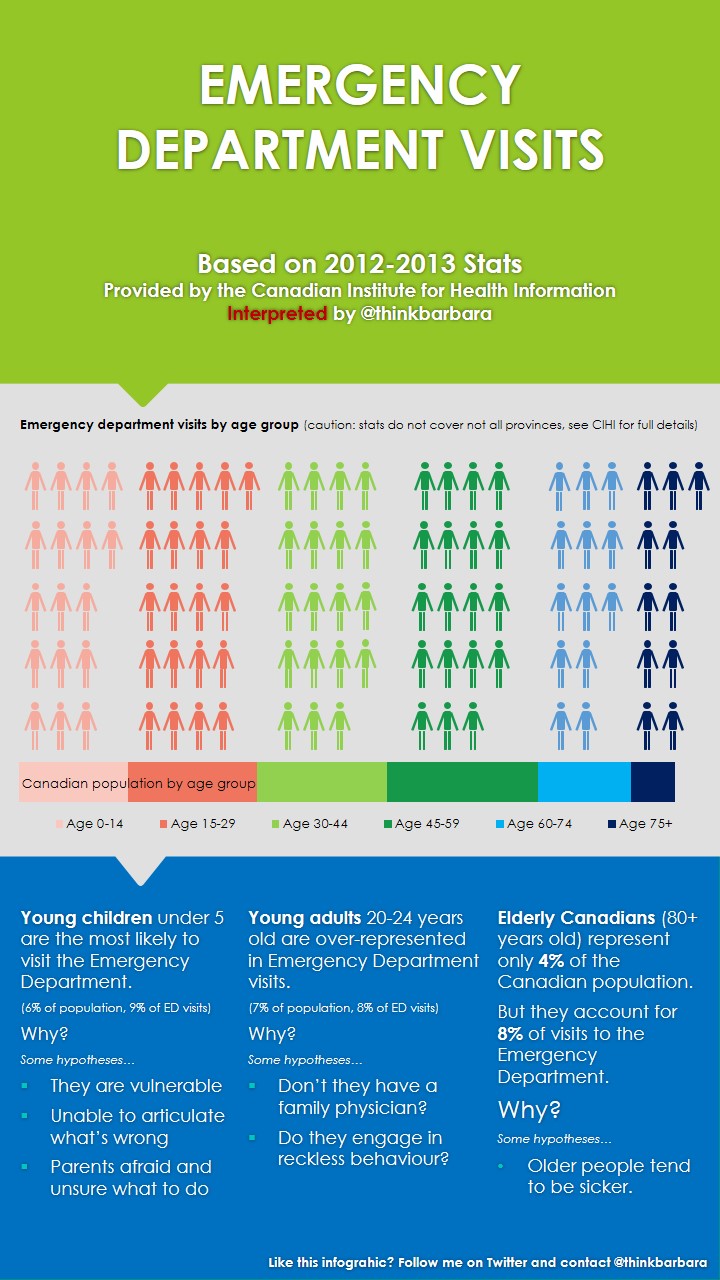
Canadian Youngsters most likely to visit Emergency Room

Trying out infographics… here are some interesting stats from the Canadian Institute for Health Information on visits to the Emergency Department in 2012-2013.  @CIHI_ICIS

ED Visits CIHI Data Feb 2014_Image

http://www.cihi.ca/CIHI-ext-portal/internet/EN/Home/home/cihi000001

The Role of Motivation in Patient Engagement

As Dave Chase @chasedave recently stated The most important medical instrument is communication, and Patient Engagement is the Blockbuster ‘drug’ of the century. The idea is that by engaging patients to become more proactively involved in the management of their own health, better outcomes can be achieved, and generally at a lower cost to the healthcare system (compared to expensive tests, procedures and medicines).

New technologies make it easier to engage patients – for example via online portals, health apps, personal electronic health records, portable monitoring devices or a clever combination of these tools within a new care model. Clearly, when the generation of texting, tweeting, vining, instagraming twenty-year olds turns fifty and start their decent into chronic illness, resistance to digital, mobile, sharable health tracking and communications technology will no longer be an issue.

Remains the issue of motivation. The people who continue to supersize their burgers and fries, do they lack awareness of the health impacts of excess weight? The schizophrenic who skips her pill because it makes her head feel fuzzy, has she not been educated on the dangers of messing with her medication regimen? Will improved communication with a healthcare provider convince my uncle to stop smoking?

Yes, there are those who suffer from inertia, who are uncertain about the right way forward or who find it hard to fit taking care of themselves into their busy days. These patients will find it helpful to be supplied with tools and supportive healthcare providers who make it easier for them to look after their own health. These patients are the low-hanging fruit for the new care models.

And then there are other people. People who will not download the app. Who will not sign up for the e-newsletter. Who do not want to be called by their pharmacy to remind them to refill their prescription. Some people will continue to do dangerous, unhealthy things because they want to. It makes them feel good, at least momentarily. Some do not want to face the realities of getting older, of their failing bodies, loss of beauty and loss of agility. Some are comfortable with the thought that this is all inevitable, and do not feel inclined to take action. Some are looking to their doctor for the quick fix, just make it go away, I don’t want to bother with it.

PtEngageUSED

Motivating people is a tricky business and tech tools are only going to do part of the work. What motivates patients to take care of themselves? Pain? The desire to live longer? A feeling of obligation? Because your mom told you to? Peer pressure? Because it is cool? Fun? Because it makes you look better?

Also, doesn’t motivation change over the course of one’s life? What motivates a twenty-five year old to track his weight loss with a health app and what motivates a seventy-year old to continue his androgen deprivation therapy would likely be very different things. Capturing the Show Me The Way segment of patients with new patient engagement tools will be easy and rewarding. Addressing the Maybe Later and the No Way segments will be much tougher, and cracking the motivation nut will be essential to make it work.

Our online and offline worlds

I am a student of human behaviour. When the Internet first became a thing, we used to compare online and offline behaviour. As if we were one person while we sit at our computer and another person in real life. Maybe it was like that in those days. I am talking ten, fifteen years ago.

The world of communication was segmented into different channels: television, radio, print etc. Talking like that does not even make sense any more. Today a typical user experience includes interacting with content and with people across a number of platforms, in a more or less fluid fashion.

Vinu George, Market Intelligence and Customer Insight Manager at Microsoft, recently described this in an article in VUE magazine as follows: We are now moving to a five- screen world…large-screen TVs, gaming consoles, laptops/PCs, tablets and smartphones. Content is now consumed and created across these screens. We are moving from one screen to the next to the next, reading, watching, posting, commenting, sharing online, sharing online offline (Look, mom, have you seen this video?).

Up until recently, I have not been a technology junky at all. But with four out of the five interfaces at my disposal, and discovering the infinite possibilities of social media, I find it more and more difficult to differentiate between online and real life, it is all just life.

Having school-aged children also gives me a privileged view into the future of online immersion. Many parenting experts advise parents on limiting screen time for their kids. Which I agree with. The trouble is, there is not just brain-dead consumption of junk going on, there are lives lived, and they are lived in part through electronic platforms.

As a market researcher, I wonder if our methodologies really address this level of immersion in the online world and the fluidity with which online and offline experiences are intertwined. Rather than focusing on one interviewing medium and throwing in a bit of social media analysis or a few ethnographic observations for good measure, how much richer and more insightful could a truly integrated multi-media exploration of behaviours and attitudes be?

Mom and baby

Sea Change in Market Research

The art and skill of market research lies in asking the right questions and drawing the right conclusions from the answers. I know how to ask questions.

I know how to ask them online, on the phone, in person, in a fashion that makes responses quantifiable, in a fashion that allow us to publish the results, in a fashion that elicits emotions, in a fashion that minimizes bias, in a fashion that entertains my clients. I know how to ask questions to old people, to young people, to people with illnesses, to people with children, to CEOs, to large donors, to physicians, to nurses, etc. etc.

In a house, with a mouse, in a box, with a fox, here and there, I can ask questions anywhere…

What if market research is no longer about asking direct questions to real, live people? Why are we asking questions anyway? Our clients want to know what people think and feel, and what they will do, based on their thoughts and feelings. How they will vote, who they will support, what they will buy.

Much of this can be elicited from data that is produced without asking questions. I recently read an article on how you can predict someone’s age, gender, sexual orientation, level of education and the emotional state he or she is in relatively accurately from the pattern of likes they leave across the Internet. Predictive modelling is the name of the game. How can you link likes, content of posts, tweets and comments to action, online and offline? The best people who develop these algorithms sit no longer in traditional market research companies.

They sit in large IT companies. Or they sit in smaller digital shops, where they specialize in a particular thing. And probably in some large financial institutions. And government think tanks.

What do they understand about people? What do they not understand about people? What do my clients need me for? Sure, I know my clients business. I consult. I interpret. I put things in context. At the end of the day, it is still all about making the right connections. So you know what pattern of online behaviour precedes a purchase. Now what? What information do you really need, and how do you use this information to your advantage? That is where the consultant comes in.

To do the job right, however, the consultant needs to understand what kind of information is out there, what is technically possible, what is practical and what is economically feasible in terms of analysis. And to stay on top of that is becoming more and more time consuming with the data explosion in which we are currently caught up…

The difference between recharging and goofing off

Taking breaks from your regular activity supposedly enhances your ability to concentrate. Consequently, the clever employer should encourage those who spend their day in front of the computer screen to interrupt their activity from time to time to relax and recharge.

I have a small beach ball in my office, a promotional item left over from some conference. What if I’d throw it up into the air? Today I tried it out: very relaxing – beats walking to the washroom or getting another cup of coffee. But I felt odd.  What would my co-workers think about me? Sure looks like I’m goofing off.

In an office environment, some forms of de-stressing are more accepted that others. Getting coffee is the top accepted de-stresser, I would say. Smoking also features high on the list – need a break, have a smoke. Going for a walk – good, but may take too long in the eyes of the boss.

Many also deal with stress by talking to their fellow employees. Probably better for your health than smoking, but can cause significant disruption of the workflow, particularly if many employees go through a stressful time at once.

Spending five minutes with a beach ball (or a skipping rope? or a mini-putt?) seems like a worthwhile alternative that should be an acceptable form of recharging – and easier to monitor than other common forms of in-office relaxation, such as constantly checking your Twitter feed or Facebook updates. Then, I think, you are basically just goofing off…

Innovation, the new normal?

Companies in many sectors are facing rapid change. Following Clayton Christensen’s terminology, established businesses are being disrupted by new technology, and new business models are developed around these technologies.

Whether it is 3D printing of medical implants, crowd sourcing of clinical trial data analysis, software that supports pre-clinical studies and identifies the most promising drug candidates, ‘big data’ capturing patients’ genomic profile or personalized health records that patients can carry from physician to physician, fundamental transformations are afoot in the healthcare industry.

Consultants to the healthcare sector struggle to stay on top of all the different angles that are emerging. How much reading can you do in a day? Should you rather update your skills in data mining (i.e. working with ‘big data’) or become an expert in social media platforms and the many ways they are being used by patients and physicians or study government initiatives to incorporate new technologies in reorganizing the way healthcare is delivered to the patient?

The state of confusion is pretty typical for market changes. Initially, there is a whirlwind of new ideas and approaches. Are electric cars going to be the way of the future or ceramic fuel cells? Or will biking emerge as ‘disruptive technology’ in a reorganized urban neighbourhood? Will patients carry their own health records around on a USB stick or will they become universally accessible through a (password protected) cloud? Will pharmaceutical companies find ways to make drug development cheaper or will fewer drugs be approved or will best supportive care with the bells and whistles of comfortable retirement living ‘disrupt’ the oncology pipeline? Will iOS, android or Windows 8 emerge as the dominant ecosystem for computer / tablet / phone or do we need to learn all three to know what works how in which environment? Etc, etc.

Should we wait until the dust settles before we decide how to focus our efforts?

I am not sure that the dust will ever settle. The pace of change is accelerating, with no sign of stopping or settling down. Then where should we pitch our tent? What should we hold on to? I believe that companies and individuals will succeed who develop mechanisms, routines, practices that allow them to deal with change. Not just once, but on an ongoing basis. Those who effectively survey what is going on in the whirlwind, who systematically capture their own ideas on how to ride the storm and who devise an easy process that allows them to test, develop and implement these ideas will have a chance.